EL117
- Michael Motas

- Nov 13, 2020
- 17 min read
Updated: Jan 4, 2021
LITERARY CRITICISM
Welcome to the Literary Criticism category. This section will be focusing more on the outputs and assessments in EL117.

(Credits to the rightful owner of the abstract photo)
Task 1
LITERARY GENRE CROSSWORD PUZZLE: FIND ME
Directions: Read the clues below and put the answers into the puzzle.

Across
2. It is an event causing great suffering, destruction, and distress, such as a serious accident, crime, or natural catastrophe.
3. It is a short story typically with animals as characters, conveying a moral.
6. It is a long poem, typically one derived from ancient oral tradition, narrating the deeds and adventures of heroic or legendary figures or the history of a nation.
9. It is a fiction in which events evoke a feeling of dread in both the characters and the reader.
10. It is the most common form of writing, used in both fiction and non-fiction.
12. It is a fiction dealing with the solution of a crime or the unraveling of secrets.
15. It is the traditional beliefs, customs, and stories of a community, passed through the generations by word of mouth.
16. It is a story based on impact of actual, imagined, or potential science, usually set in the future or on other planets.
17. It is a play for theater, radio, or television.
18. It is an informational text dealing with an actual, real-life subject.
20. It is a subgenre of comedy and slice-of-life fiction, focusing on lighthearted, humorous plot lines centered on romantic ideas, such as how true love is able to surmount most obstacles.
Down
1. It featuring characters involved in exciting and usually dangerous activities and adventures.
4. It is the faculty or activity of imagining things, especially things that are impossible or improbable.
5. It is a story, sometimes of a national or folk hero, which has a basis in fact but also includes imaginative material.
7. It is a type of novel and genre fiction which places its primary focus on the relationship and romantic love between two people.
8. It is a literary genre and a type of dramatic work that is amusing and satirical in its tone, mostly having a cheerful ending.
11. It is a traditional story, especially one concerning the early history of a people or explaining some natural or social phenomenon, and typically involving supernatural beings or events.
13. It is a genre of fiction, having numerous, often overlapping subgenres.
14. It is a children's story in a magical setting about imaginary characters that include fairies, dwarfs, witches, angels, trolls, and talking animals.
19. It includes representations of recent events whose social significance is recognized by contemporaries.
Task 2
Infographics: Early Periods of Literature and Later/Modern Periods of Literature

A FORMALIST ANALYSIS OF THE STORY ENTITLED “THE TELL-TALE HEART” WRITTEN BY EDGAR ALLAN POE
MOTAS, MICHAEL A.
DECEMBER 2020
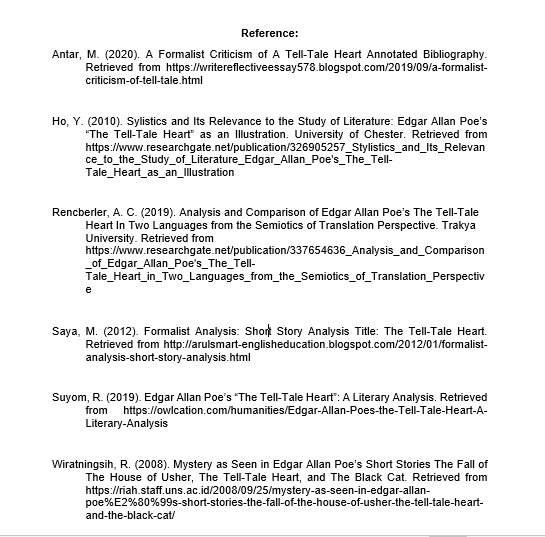
The story entitled “The Tell-Tale Heart” touches on the life of an old man who became the victim of a murder from the caretaker. The author perceives and take into consideration the idea of the conscience and might as well interprets the monologue as sexual in nature just before the murder. The story is told from the first-person point of view, through the eyes of the madman. He attempts to convince the reader that he is sane and that he just suffers from acute senses. This perspective helps develop the inherent ironies in the story, as the reader understands the truth much differently from the madman (Saya, 2012). Moreover, the story was told by a first-person point of view and as a matter of fact the way the author portrayed his anecdote was quite appealed and disrupted. Appealing in a sense that it captures the reader’s attention to really know the whole truth of the story and the study of text; might as well it is disrupted in a sense that the madman became a murderer because of his overly acute senses. Hence, the idea of the madman himself tells the use that his precision in killing the old man means that he could not possibly gone insane and that’s the reason why he committed such hideous misdemeanor inside the house of the dead old man.
In the analysis the story applies to reveal the appearance of mystery in the three short stories crafted by Edgar Allan Poe. There are two approaches used in every study of a work of art that are formalism and structuralism. Formalism sees literary work as a world of words (Wiratningsih, 2008). In addition, formalism is an approach that masters the language or understanding about the meaning of the words in the work. Whereas, it is not easy to acknowledge the right meaning of the words in a work instantly. It can be multi-interpretable and I assume that as a reader we have our own variations when it comes to simplification. The sense of words and its context is needed to dig up the implicative and connotative meaning, such as the case in Poe’s projects that are eccentric (he puts the unique object, unique setting, unique theme, and unique characters) and are dense to study. So, formalism somehow help out a lot of researchers and is fundamental to help comprehend the meaning of words in an anecdote.
The narrator hears the heartbeat muffled by the bed, but rationalizes the neighbor’s idea of hearing it. The neighbors could hear scream, but not the heartbeats. Knowing this, the reader cannot disengage from the monologue. The reader is trapped like the narrator. Poe uses these devices brilliantly to place the audience in the insane mind of a killer (Antar, 2020). On the other hand, the storyteller, of whom the reader knows nothing such as the sex, the age, and the relationship to the old man admits to loving the victim but notably hating his evil eye. The way the story narrated was tumbledown as forensic oratory, a defense rather than a confession. That means, the murderer’s conscience awaken himself and with that being said his action was immensely revealed in no time. The characters are beguiling because of the absence of clear-cut descriptions. There was an unsure definition of their gender, their age, their occupation, or their motive. “Lines such as the narrator’s statements throw little light on him and other characters. Notice how he described himself with "True! - nervous - very, very dreadfully nervous I had been and am; but why will you say that I am mad?" (Suyom, 2019). Besides, this line was duplicated often times in the anecdote as if consoling himself or stressing his sanity to anyone, yet there was no sure spectator for his statements. This certain line shows the description of the characters through the eyes of the narrator.
Leech and Short’s checklist will be applied to analyzing the style and effect of a tale terror – “The Tell-Tale Heart” – by Edgar Allan Poe. In his major discussions of literary principles, Poe insisted that a good short story accomplished its unity by achieving a single emotional effect on the reader and that each statement of a story contributes to its total effect (Ho, 2010). Furthermore, the Tell-Tale Heart written by Edgar Allan Poe was way a perfect scheme of demonstration of his “single effect” proposition. The way the stylistic approaches of Poe had been given out, and how the sense of “terror” was manufactured through the language of the text and how readers were affected accordingly. On a serious note, as a reader and as an analyst, I could associate the scope and heterogeneousness of lexis used by the writer in the given text. In other words, the ratio told us about the lexical density of the chosen text. It was defensible that the low lexical density, syntactic simplicity and simple vocabulary of the text were the first dormant factors that bestow to the total effect, as they presumably facilitate the reading process and help readers centralize on the terrorizing matter that had been described by the narrator.
The text seems suitable for more than one reading code: crime fiction and psychological fiction. The readers could interpret the story as crime fiction as the narrator renders his plot of murder step by step and imparts why and how he would kill the old man, how he would cut and hide the body throughout his narration. It can be read as psychological fiction because of revealing the unreasonable motivation of the murder (Rencberler. 2019). In addition, the way the writer persuaded his fictions were a best strategy to stir up the mind’s reader. In the same way, the literary texts that have been castoff in the anecdote could correspond and may be rewritten by different words. The credentials of the texts into social, cultural, economic, historical, and other literary elements and the intertextuality relations can bring forth a pivotal statistic to the reader and that may contribute to outspread translation.
Therefore, I conclude that the choice of lexis used by the writer tend to be profound and have need of higher skills of exposition. Another commodity when it comes to the theme of the story was about the human nature and it highly delicate a balance of light and of dark, or of good and of evil in a person’s life. Most of the time, this precarious proportion was maintained; however, when there was a major switch, of the whole story, for whatever reason, the dark or perverse side emerges. How and why this dark side of ours arises differs from one person to another. What may shove one individual over the edge would only cause another to raise an eyebrow. On a serious note, the anecdote speaks for the facility of the elements to generate mystery; a mystery which makes not only retailing and advancement achieve their various objectives but also instilling a name and a brand recall that is signature of Edgar Allan Poe, the prominent writer of the story.
A POST STRUCTURALIST ANALYSIS OF THE STORY ENTITLED “A CHRISTMAS STORY” WRITTEN BY WALTER DEAN MYERS
MOTAS, MICHAEL A.
DECEMBER, 2020
The story entitled “A Christmas Story” written by Walter Dean Myers is a well verse and elegant story for people who have a genuine and a generous heart to spare their Christmas Holidays to others. The story portrays about the celebration of happiness despite of misunderstanding of O’Brien and his dear wife. A lot of people celebrate Christmas by being with family and might as well eating delicious foods and sharing laughter’s together. But as the storyline goes, instead of celebrating their Christmas at their respective home, the wife decided to celebrate the other way around and went to Mother Fletcher’s house to celebrate their Christmas eve. The true meaning of Christmas is not about evolving in the inner circle of the family, but it’s all about the spirit of giving and sharing their time and love to other people. Certainly, Christmas is a time of giving and sharing with those people who surround around us. To be honest, sharing something valuable is not limited to those that we love and care for. It is also for the person that we have never met and will never see; moreover, those human beings that are less fortunate in their lives as we are and that we could use a helping hand.
Christmas is a time of generosity and sharing to one another say for example like giving Christmas gifts, and celebrating together with the family. It can be throwing a few coins into the bell ringer's bucket; it can be giving our time and work when we would rather be home, warm and comfortable; or it can be sharing our own Christmas. We often invite someone without nearby family to share our enjoyment of Christmas dinner and the camaraderie of the day. It all adds to the wonder of Christmas, and we are never poorer for doing it (Harmon, 2019). Indeed, Christmas is a season for everyone to enjoy and to worry-less. The true meaning of Christmas has many definitions to us. It means the sharing of ourselves with others. It means reviving the old traditions that we have formed over the previous years and remembering our past. Also, it means promoting and participating in the magic and wonder that children find in Christmas and most importantly, it is a time of love and generosity. In the story, it was portrayed the generosity of Mother Fletcher to the Police officer. She gave him her crafted soft and warmth sweater and her wife, too. According to Nitin Khaire (2020), “Humans are hard-wired for generosity. It is a season during which people are more eager than usual to give to others. This includes family, friends, colleagues, well-wishers, and even strangers. Giving is an act of kindness whose benefits are greater than most of us recognize.” On the other hand, people have a sole art of generosity inside their hearts and extending their ceaseless love to stranger ones. People give when they know that their donations are going to make a difference in the lives of other people. In other words, being generous helps release chemical hormones like endorphins and dopamine. Both of these hormones give a person a pleasurable sense of reward and well-being. Thus, giving something to people feels great in the deepest part of your being.
It was stated in the story that “And the Christmas dinner wasn’t the best that O’Briens would ever have but it was far from being the worst. But then, that’s not what this story is about. This story is about how a policeman’s young family brought a few hours of happiness to an old woman. Or perhaps it’s about how an old woman taught a young family something about sharing. Or maybe, just maybe, it is about how a six-year-old girl found the only person in the world who played catch with Santa Claus when he was a little boy, even though she was a lot older than he was.” Consequently, these lines strike me the most because it is not easy to celebrate alone during Christmas eve (personal experience) and in fact the life of Mother Fletcher is somewhat fascinating in a way that she gives the young family the hope, the love, the true meaning of sacrifice and the peace beneath upon them. According to Jane Trina (2015), “Traditions brings family together. When you come together and take part in a family tradition everyone has a sense of belonging. This is so important for children because it helps them feel accepted and part of the family unit. This is a major when they get older because they are then less likely to seek for outside acceptance because they feel so close with their own family.” In addition, the importance of holiday traditions for families have a huge impact to children because they are emotionally sensitive and through the celebration of holidays, it will help them build sustainability and a sense of belonging that will prevail on their own selves. Just like what the child did in the story, instead of listening to what his father told to them to not come in Mother Fletcher’s house, the child still chose to celebrate and visit the house of the old woman.
Christmas is one of those holidays that just seem to be filled with cheers and wonders. It is a day for fun, love, and happiness, rejoicing getting together as families. Spend time quietly being thankful for the gift of Jesus to the world that we celebrate on Christmas (Kibuuka, 2020). Likewise, since people celebrate the greatest gift of incarnation, which happened in a family of Joseph and Mary, then Christmas can best be celebrated as a family. The most essential thing to do during the Christmas holidays is to get together with people you love and make a traditional Christmas dinner complete with roast turkey, or pork, or chicken, or create your own traditions by branching out and making whatever you want. From home to home, and heart to heart, from one place to another the warmth and joy of Christmas brings us closer to one another. According to Jean-Luc Butel, et. al. (2018), “Our celebration of Christmas should also reflect the love and selflessness taught by the Savior. Giving, not getting, brings the full joy of Christmas. We feel kind toward others. We reach out in love to help those less fortunate. Our hearts are softened, enemies forgiven, friends remembered and God obeyed.” Hence, people should embrace the idea that Christmas is about true compassion. Looking back, I saw that the wonderment of my childhood memories during Christmas were truly blazing, and the longing I felt to keep it with me forever, was an invitation God was writing on my heart. He wanted me to experience something far greater than my present-tense life. There was so much more to discover about the baby in the manger and the love that had sent Him. Christmas really could last forever. He still speaks and invites us to Himself. He is ever pursuing, and always ready to receive us. Christmas is about love, because God is love and the best present on Christmas is spending some good time with family realizing the importance of love, sharing things that give you real joy.
Therefore, I conclude, Christmas all over the world is a special event and a magical holiday loved by many people even if you are young and old. There is so much to learn about the season of Christmas around us. The Christmas season make us appreciate everything that the year has brought to people. No matter if the year is bad or good, it is a time for reflection on ways that your life can be improved for the next year to come and a time of God showing His great love for us. On a serious note, it can be a time of healing and renewed strength. Christmas is a season not only of rejoicing but of reflection.

A NEW HISTORICIST ANALYSIS OF THE STORY ENTITLED “LES MISERABLES” WRITTEN BY VICTOR HUGO
MOTAS, MICHAEL A.
DECEMBER, 2020
Les Misérables is a French historical novel written by Victor Hugo. It was first published in 1862 and that was considered one of the greatest novels of the 19th century. In the English-speaking world, the novel was usually referred to by its original French title. Let us try to criticize this novel by the used of the new historicism, since it was an approach that focuses on the history, of course, critics must be based on facts. According to Alfar (2015), the events which they are about to relate belong to that dramatic and living reality which the historian sometimes neglects, for lack of time and space. In them, however, we insist, the palpitation, and the quivering of humanity. Little incidents, are, so to speak, the foliage of great events and are lost in the distance of history. The novel Les Misérables is way romantic in style and theme. Hence, it is also written in a sweeping, emotional manner, taking the experience of the readers to discover facts about French society. Somehow through this written novel, people have known the idea of a momentous era of the French history and might as well the little society’s indifference and injustice of those who fall in the latter category.
Shockingly, the only time the viewer may really realize that Les Misérables is set in Paris is during Javert’s two solo’s when he teeters precariously on the ledge of the Palais de Justice in front of Notre Dame and later on a bridge high above the Seine. Even then, the viewer only sees a quick and blurred view of Paris at night (Gossard, 2013). Moreover, despite its many triumphs, somehow critiques would have said that this novel precariously lacks historical context and may leave viewers scratching their heads about the basic plot elements. Similar to indentured servitude, young girls in the novel were employed as domestic servants in households throughout Europe. Mostly, they are paid at the end of their terms; however, these domestic servants were usually allowed to live in the household which provided with own quarters and, under coverture laws, were legally dependent upon the head of the household they lived in. For many single mothers like Fantine, which another major character in the novel who could probably not afford to care for Cosette completely, let alone watch her during the day, sending a child away to work and live would have been a difficult, yet necessary decision. In the story of Les Misérables, Valjean's relatively tranquil existence becomes imperiled when Cosette falls in love with Marius, a young member of "Friends of the ABC," a fictional organization created by author Hugo that mirrors many of the small revolutionary groups of the time. (Bradford, 2019). However, Valjean risks his life by joining the rebellion in order to save Marius. As the end of the uprising has come, and as depicted in the novel and musical, the June Rebellion did not end well for the rebels. They expected that the people would support their cause; however, they soon realized that no reinforcements would be joining them.
According to Professor Robert Tombs (2015) “the story itself is Hugo’s fantasy, but it was important to have the surface details accurate to make it believable.” In addition to, I think people’s idea about the overall production of the novel is quite exemplary. In a way that both the necessarily simplified story and the whole appearance of the characters and the locations are faithful to the original and to the historical period, and it looks so fantastic. As I’ve watched the movie version of the novel, it was really dope and Jean Valjean has a better-looking characteristic and more charming than the conventional idea of the character. Also, it will be fascinating to see how he ages as the story progresses. Fans describe the story as a universal one of “eternal truths” and societal “archetypes”, but Jean Valjean’s problem is his relationship with a government that not only misuses and perverts its power, but facilitates and reproduces a society that is perversely stratified. Granting that Jean Valjean’s saint-like quest for personal salvation forms the redemptive core of the story, what if the global popularity of this work also echoes the perennial frustration with government’s interminable persecution of innocents and its obsessive zeal for crushing liberator movements? (Turner, 2013). Similarly, the perennial hostility of critics would then remind us more of the nervous murmurs and outright hostility of elites whenever the masses begin to congregate, build barricades, camp out and demand a better world. The tears of the audiences would not remind us that the “people” are easily conned into weeping over a melodramatic spectacle that apes the gospels, but perhaps allows a vicarious vision of rebelling against unjust rule while remaining true to desire and to love. There are many of Les Misérables contradictions and the divergence of responses can be teased out by examining its author. In an epoch of societal contradiction, one would be hard pressed to find a greater contradiction than the life of Victor Hugo.
As a result of these great changes, the people suffered, and those who suffered the most were, naturally, the proletariat. The characters within Les Misérables reflect the society, and its challenges, in the 1800s in France. Although the national proverb of France became “liberty, equality, and fraternity”, for the people of Parisian society, this was not the reality. Hugo was concerned with portraying the struggles between social classes in Parisian society, and goes so far as to even state this in the preface to the novel. (Writer, 2019). In the same way, Victor Hugo really presents the quest idea and there is a need for a social equality in Parisian society. He presents some of great ideas related to Marxism through his presentation of the character of Jean Valjean, an ex-convict. When Valjean is released from prison, he is turned away at every door because he is a convict even though he has money to pay. He exclaims, “I am not even a dog!” This exclamation shows Valjean as being entirely dehumanized by his time in prison, by his conviction and becomes even lower than the base structure of society. As a result, he is left dehumanized and rejected by a society for being a convict; thus, he is convicted for stealing bread, and then more years are added to his sentence for attempting to escape.
New Historicist’s study material artifacts that have been influenced by political, social, and cultural societies. Writers such as Michel Foucault, Stephen Greenblatt, Steven Knapp, and Walter Benn Michaels have paved the way for New Historicist’s. The theory often analyzes the author and theme relationship, which the two are compared to the text and how they correlate (Brandon, 2019). Moreover, Hugo’s experience of revolution is not going to explain the vicissitudes and disparities of reaction towards his prose masterwork Les Misérables and its many incarnations. But it allows us a glimpse of a consciousness under transition, willing to have his convictions under a constant process of revision. The experience of Les Misérables undergoes a similar process of extremes colliding from different societal and political vectors. Whatever one’s opinion of the artistic merits of the novel, musical or film, which certainly are different projects under different cultural regimes, one would be wrong in failing to acknowledge the duty it undertakes to embrace a vast breadth of society, from the Misérables on up. Les Misérables stands in-between — in between the rich and the poor, the good and the bad, the guilty and innocent, the white and the black, the poetic and the purple, the right and the left.
Therefore, I conclude that the gap between the rich and the poor was monumental. The aristocracy often enjoyed a quite carefree lifestyle, while the poor suffered. Valjean is forced to steal because of poverty, (poverty being one of the three main issues Hugo outlines in his preface), and he is sent to prison for a minor crime and is dehumanized because of it. This idea of dehumanization is in line with Marx’s belief that, according to critic Peter Singer, Marx believed that “economics is the chief form of human alienation,” presenting the idea that poverty leads to the loss of self, as is shown through the character of Jean Valjean. In giving a voice to the marginalized society, however, Hugo could inadvertently be going against the proletariat, as Hugo is a middle-class writer, so through his narration he provides the poor with a sense of false hope rather than the voice they need. Victor Hugo portrays the need for revolution for an equal society, through his positive portrayal of those of the ABC Society, and a more so negative presentation of those with power, such as police inspector Javert. On a serious note, through these portrayals and his social critique of Parisian societal structures, Victor Hugo presents many significant Marxist ideas in Les Misérables.


Comments